‘YOU Caused This’: Obama Slammed For His Statement On Charlie Kirk

By Staff Writer – Fictional Report
The shocking assassination of conservative activist Charles “Kirkson” — a figure loosely modeled after real-life political commentators — has sent ripples through the American political landscape, igniting fierce debates about rhetoric, responsibility, and the climate of polarization in the United States. While law enforcement continues to investigate the deadly shooting in Utah, politicians and pundits from across the spectrum have already clashed publicly over who bears the blame.
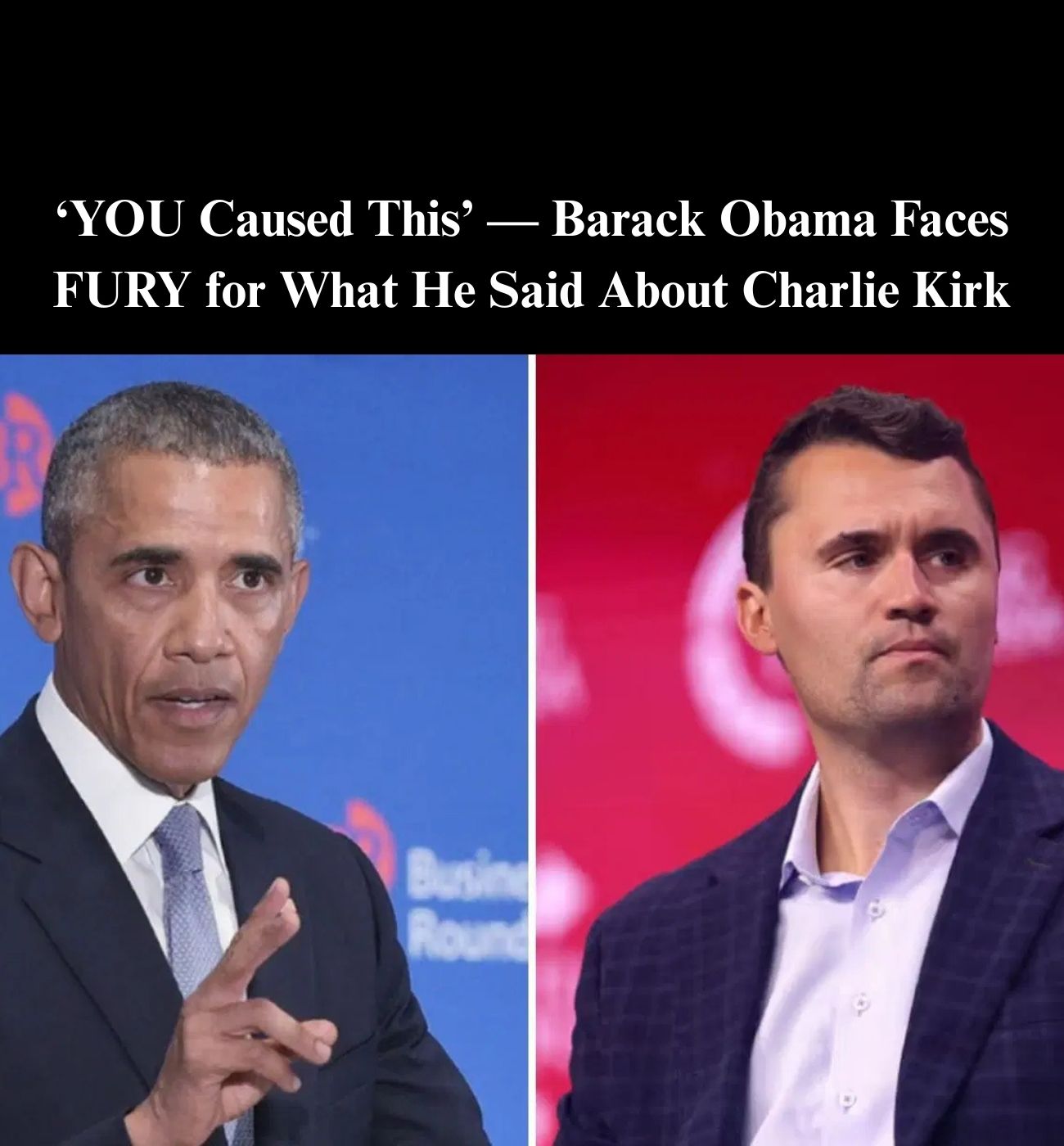
Former President Barack Obama issued a statement within hours of the attack, calling the murder “a heartbreaking act of violence that should have no place in America.” He urged calm, extended prayers to the family, and called for unity in condemning political extremism. Yet critics immediately pounced on his words, with some claiming that his measured tone came across as detached. On social media, detractors described the statement as “tone deaf” and accused the former president of ignoring the deeper causes of such violence.
Among the loudest voices of criticism was Fox News host Clay Travers, who argued during a primetime segment that Democrats — including Obama — have spent years vilifying conservatives by comparing them to authoritarian regimes or extremist groups. According to Travers, such rhetoric doesn’t just inflame tensions but emboldens individuals who might be prone to violence. “When you call everyday Americans Nazis, don’t act shocked when someone takes those words literally,” Travers declared, drawing applause from his studio audience.
Meanwhile, Democratic leaders pushed back against accusations that their language contributed to the volatile climate. Senator Elizabeth Warren, speaking to reporters in Boston, dismissed the claim outright. “Why don’t you start with the President?” she asked, pointing the finger at Donald Trump for what she characterized as years of inflammatory remarks that normalized hostility in public discourse. “Blaming Democrats for this tragedy is not only wrong, it’s a dangerous distraction,” she said.
As the political blame game escalated, the FBI held a press briefing to share preliminary details of the investigation. Officials confirmed that the shooting was a targeted attack and that the suspect — whose identity has not yet been released — appeared to have fired from a rooftop near the venue where Kirkson was speaking. Witnesses reported seeing a figure in dark clothing fleeing the area shortly afterward. Authorities are asking the public to submit any tips, photos, or videos that may aid in the investigation.
The bureau also emphasized that the motive remains under investigation, though they acknowledged that the high-profile political nature of the victim suggests ideology may have played a role. “We cannot confirm motive at this stage, but we are treating this as a deliberate, targeted act,” the lead investigator told reporters.
Former President Donald Trump wasted no time weighing in. Speaking at a rally in Ohio, he squarely blamed what he called “radical Left rhetoric” for fostering the environment that led to Kirkson’s death. “These are the people who preach tolerance but practice hate,” Trump said to thunderous cheers. “They’ve been demonizing us for years, and now we see the consequences.”
His remarks drew immediate pushback from Democratic officials, who accused Trump of exploiting a tragedy to score political points. Yet among his supporters, the speech resonated as a rallying cry, further entrenching divisions between the two camps.
Beyond the immediate reactions, the assassination has reopened broader questions about the role of political speech in America’s polarized climate. Experts warn that the increasingly hostile tone of national discourse has created fertile ground for violence. Dr. Lena Ramirez, a political scientist at Georgetown University, noted, “When political opponents are portrayed not just as adversaries but as existential threats, it lowers the barriers to violence. Words matter, and the temperature of our rhetoric has consequences.”
Civil rights groups have echoed those concerns, urging leaders from both sides to exercise caution in their statements. The Southern Coalition for Civic Harmony released a statement calling for a “national recommitment to nonviolence in politics.” They warned that if current trends continue, the U.S. could face an escalation of politically motivated attacks.
Meanwhile, ordinary citizens are grappling with the implications of the shooting. In Utah, mourners gathered for candlelight vigils, some holding signs that read “Stop the Hate” while others carried banners supporting Kirkson’s political cause. Online, hashtags memorializing the activist trended for hours, alongside heated debates about responsibility and free speech.
For now, the investigation continues, and the country waits for answers. But one reality is clear: the killing of Charles “Kirkson” has already deepened America’s political divides. Whether it ultimately serves as a turning point — pushing leaders toward unity or further entrenching hostility — remains to be seen.